Running Time: 240 Minutes (4 hours)
1.33:1 Fullscreen (Original Aspect Ratio) / Dolby Digital Mono (English)
Rating: Not Rated / Originally Released and Broadcast between 1950 and 1961
Subtitles: English; Closed Captioned / DVD Release Date: December 5, 2006
Two single-sided, dual-layered discs (DVD-9); Suggested Retail Price: $32.99
Today, to observe nature, you only need to flip through channels until you find something; there's Discovery Channel, Animal Planet, digital cable's National Geographic Channel, and a fairly regular supply of nature specials on PBS. That was not the case fifty years ago, when television was in its early stages and options were limited. Then, Walt Disney's True-Life Adventures were pioneering, offering moviegoing audiences a unique opportunity to view interesting creatures from around the world not behind bars at the zoo, but out and about in the great outdoors.
The series of nature documentaries came as feature-length films and two-reel shorts, beginning with 1948's Seal Island and running through 1960's Jungle Cat. Nature films are something of a niche market in cinemas today, with most relegated to television broadcasts, some fortunate enough to play on the IMAX screen (with museums, zoos, and field trips contributing heavily to viewership),
and only the rarest (like last year's surprise hit The March of the Penguins) lucky enough to make it big in wide release. But 58 years ago, the cinematic playing field was quite different. Walt Disney's True-Life Adventures garnered critical acclaim from the start, with Seal Island winning the Academy Award for Best Short and beginning a trend that would yield seven additional Oscars for the line's output in the 1950s.
That didn't mean there was widespread acceptance; in fact, a dispute between Walt Disney's studio and regular distributor RKO Radio Pictures over the value of the True-Life Adventures led to Disney establishing his own distribution arm, called Buena Vista, in 1953. While RKO would fold just six years later, Buena Vista lives on today, as the company which distributes movies and television shows with the best of Hollywood. Buena Vista's first film was a True-Life Adventure -- 1953's The Living Desert -- which showed that the series' appeal needn't be questioned by earning $5 million (chump change today, but no small figure back then) on a budget of just $500,000.
That the True-Life Adventure banner was dropped after just twelve years may lead you to think that the line was a bust, but in fact, Walt continued to bring captivating and well-compiled footage of the Earth's wonders in their natural environment. Instead of theaters, though, they reached the general public via his weekly anthology series that was initially called "Disneyland" and subsequently known under a variety of titles. Realistic portrayal of animals remained a staple of live action dramas and (as time progressed) comedies, some -- like 1967's Charlie, the Lonesome Cougar -- very much in the True-Life mold. The spirit of the series can even be traced to some of the Walt Disney Company's modern-day films, like 1989's Cheetah or this year's unexpected hit Eight Below.
Of course, the True-Life Adventures can't be deemed the crowning achievement of Walt's fifty-year career in show business. While families and children of today still are gaga for even Walt's earliest animated features and regularly flock to the theme parks he conceived, the True-Life Adventures have faded a bit from the public's consciousness. The same can be said for scripted live action films from Walt's time, but there are still enough of them (like Old Yeller, The Parent Trap, and Mary Poppins) that remain rites of passage several generations since they were first made. Ask a kid today what they think of Seal Island, Bear Country, Jungle Cat, or Olympic Elk and they might think you are asking about a video game, a vacation spot, or an actual animal before hazarding a guess that you are in fact referring to one of Walt's True-Life Adventures.
Don't be discouraged. The thirteen films officially designated True-Life Adventures and their closely-related brethren are ripe today for being rediscovered thanks to the launch of a brand new Disney fan-friendly DVD line called Walt Disney's Legacy Collection. That they are old-fashioned is undisputable; these documentaries are old. But they are anything but outdated, as their impressive images and informative narration are as relevant, compelling, and fascinating today as they ever were.
The True-Life Adventures adhere to a formula, but it is a winning one that is repeatedly employed. Each starts with an animated opening, in which a paint brush appears to produce a landscape in a particular corner of the globe. The movie then proceeds to the location in question for a close look at the animals and environment there. Making sense of the largely silent film is narration by longtime Disney writer Winston Hibler.
Hibler's narration doesn't assume any prior knowledge from the viewer, which even today is appreciated; with all the information available to us, how much of it sticks, especially that which isn't initially presented in a memorable way? His words describe the ways of nature captured on film and not in a way that is educational, preachy, or boring. Instead, he makes the foreign visuals accessible, even occasionally injecting gentle wry humor which is supported in the entertaining presentation.
Sounds appear to be largely synthesized, the result of there being insufficient technology (or perhaps funding) to clearly capture audio from the various global settings. Still, the action is constantly complemented by the sound... of music. Instrumental scores play a key role in the True-Life Adventures, frequently punctuating actions both big and small. Some may argue this presence is overbearing or that its effect is manipulative. While that's not untrue, manipulation is common in cinema and the music here seems to serve the visuals, rather than vice-versa. Of course, nature itself is like a 24-hour grocery store; it's always there for you and most of the time, there's nothing out of the ordinary. That's where editing comes in, another area in which the True-Life Adventures excel. Though these movies do not provide traditional narrative filmmaking, they're still telling stories -- ones that may have existed for several hundreds of years and which will continue to do so. But these are stories not everyone knows. Even with all the nature documentaries that have aired on TV or been shown in cinemas, I came away from these films learning plenty and not in a "Will this be on the midterm?" way.
Walt Disney's True-Life Adventures may have some shortcomings and not all of the facts may remain unquestionable these 50-60 years later, but the fact of the matter is that they are highly entertaining and make it so easy to appreciate animal life that the benefits clearly outweigh any negatives. The filmmaking methods and narration may be dated, but as conveyed in a bonus feature, the films aspire to timelessness and more than half a century after many of them debuted, they seem to have achieved it.
Volume 3: Creatures of the Wild is bound to excite fans of some of the better-known wild animals. This two-disc set serves up a pair of films -- 1955's The African Lion and 1960's Jungle Cat -- that while deemed feature-length, barely exceed the hour mark and certainly don't wear out their welcome. They are the definite highlight of the set. It also contains a pair of two-reel shorts -- the Oscar-winning Bear Country (1953) and less inspired Olympic Elk (1952) that accompanied Disney animated classics in theaters. Though deemed extras, two halves of "Disneyland" anthology episodes round out what most will consider the "featured" content, one providing a behind-the-scenes look at the filming of African Lion (which took three years) and the other offering a True-Life-type profile of Yellowstone National Park. Supplements new and old complement the rest in a package that is sure to please anyone with fond memories of this nature documentary series and bound to make an introduction as painless as possible for the unacquainted.
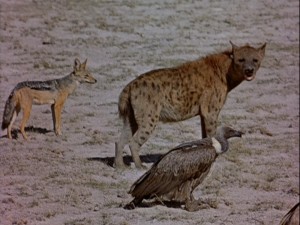
As you'd expect, the lazy king of beasts does secure more screentime than any of the creatures over which it rules, but this is definitely an ensemble documentary, and a highly involving one at that. Among those given treatment here are baboons, elephants (whose long life expectancy is exaggeratedly stated, but illustrated by a single-tusked old-timer), giraffes (engaging in sparring practice), temperamental rhinos, hippopotamuses (and the "beautician" birds that perch on and preen them), ostriches, a cunning leopard, slow-witted and often-targeted wildebeest, and nature's premier hunter, the cheetah. Three types of scavengers -- vultures, hyenas, and jackals -- are shown mooching off a lionesses' kill. Even those more briefly glimpsed at, like a retreating family of warthogs, make a memorable impression. One emerges with knowledge of and appreciation for the diverse species which share the heart of Africa. What will stick with you as much as the amusing moments (like playful lion cubs and elephant dust baths) are the harsh elements of nature unflinchingly depicted: dust storms, the erratic levels of essential water and food supplies, a plague of locusts, and a no-holds-barred group lion feast.
This final True-Life Adventure would also appear to be one of the best, as we go into the South American jungle to observe the jaguar.
Jungle Cat is more intimate than its kin, allowing individual animal characters to be developed. Central to the cast is a pair of jaguars (one ebony), whose fighting leads to love and, not long after, two babies (one resembling each parent). As in Lion, other creatures in the area also get sufficiently documented. Among these are curious otters, strange-looking anteaters, crocodiles, flamingoes, lizards, and a number of tropical birds. Naturally, some time is spent with the jaguar family, as the cubs are introduced to bathing and hunting while their elders battle with a pirarucu (a 7-foot "burping" fish) and an equally formidable boa. The secondary personalities are equally compelling: the antics of bratty, mischievous monkeys amuse, as do the appearances of tamarins and one "idiot cousin" whose insatiable appetite for snake-tormenting leads to his demise. Then there are the sloths, who participate in a climactic sequence as suspenseful as anything scripted, sluggishly trying to escape from both an uncharacteristic fall into water and a hungry jaguar. Segments like these certainly justify the "adventure" part of the series' title.
Bear Country / Running Time: 32:50 / Theatrical Release: February 5, 1953
This Oscar-winning two-reel short charts the life of black bears from one winter to another. It explores parenting in the family dynamic: how a mother bear turns to trees for her cubs' safety, but disciplines against leisurely climbs. Also covered are hibernation, the bears' diverse human-like diet, and the mating battles that occur among adult males. The best footage indulges in the bears' recreational activities; we see them playing their version of "tag", wrestling, and (via a musical montage) scratching themselves a lot. Other inhabitants of Bear Country observed include marmots, coyotes, squirrels, and porcupines. Two of the more memorable scenes find a baby moose learning to walk and a gopher fighting off a preying bird.
If that brutish behavior isn't enough to turn you off, then wait until you see how the polygamous bull males gather up wives and do battle with another (with wives as a wager) before unmelodically announcing the end of their bachelorhood.
"Cameras in Africa" / Running Time: 19:37 / Original Air Date: December 29, 1954
In this first of two "Disneyland" anthology episode excerpts, True-Life Adventures photographer Al Milotte recounts his adventures in filming The African Lion with his wife Elma. A fair amount of this merely recaps things depicted in the movie; though, then upon its initial airing, it was an extended far-in-advance preview, as Lion wouldn't open in theaters for another nine months. More interesting is the footage of Al and Elma settling into an African "rest game", showing off their stock of canned foods, and eating on the job, as this material effectively puts human faces behind the cameras. Al also reveals what happened to the trapped rhino seen in the movie. Beaver Valley, which shared the hour-long slot with this, is dropped; it appears on the True-Life Adventures, Volume 1 DVD.
"The Yellowstone Story" / Running Time: 17:20 / Original Air Date: May 1, 1957
Yellowstone, America's largest and oldest national park, gets profiled in this episode. Regular True-Life director James Algar narrates, covering the park's origins and its natural wonders. Among the latter, geysers are admired (particularly Old Faithful), while canyons and springs are also briefly seen. Eventually, we come to a bit of wildlife (buffalo, elk) and arrive at the climax/highlight: tourists being entertained in the streets by the up close and personal antics of bears who approach cars and (against park rules) get fed. This represents a bit less than half an episode, as it was paired up with Bear Country, which is mentioned but wisely not duplicated here.
That's pretty amazing, considering the demands of a True-Life Adventures filmmaker spending years trying to get footage in the face of challenging conditions and a necessary need to not intrude on the natural order. The work done here illustrates just how excellent DVD can allow films that are half a century old to look, with some time, money, technology, and talent. Of course, that doesn't reflect too well on the dozens of more popular live action Disney works that have come to disc via cheap and rubbish-looking transfers.
Reduced to bonus feature status, the two black and white anthology episodes -- "Cameras in Africa" and even more so "Yellowstone Story" -- are plagued by a lot of distracting print intrusions, though some of these let up as the shows progress. Interestingly, though they have common roots (as mid-'50s Disney television) and problems (dirty prints), their woes are different: "Cameras" showcases white speckles, while "Yellowstone" is marred by black marks.
Unsurprisingly, the audio comes by way of plain two-channel Mono tracks. That's faithful to the original presentations and the soundtracks remain almost completely untroubled. I did notice one tiny stretch in which Winston Hibler's narration sounded a little muffled and muddled, but this was not a huge drawback and not an incident I found repeated. The fact that the technology of the time didn't often enable usable recordings of the animals filmed definitely is disappointing, but this complaint is one that would have been voiced over 50 years ago. As such, it's nice that Roy Disney and company haven't pulled a George Lucas and decided to make these movies "better" in a revisionist way.
Though the "Coming Soon" disclaimer at the end seems odd since one of the DVDs foreshadowed is already in your player, the preview does also mention two upcoming volumes: The Adventures of Oswald (which will preserve the few existing shorts of Walt's lucky Rabbit whose stardom preceded Mickey Mouse's) and Destino (the Walt Disney/Salvador Dali collaboration finally completed in 2003). This promo is not accessible from the menu, but the second one is. It's a 2-minute, volume-specific introduction to the set given by Roy Disney from Disney's Animal Kingdom. He provides background information on some of the featured movies and an overview of the included bonus features.
The rest of the bonus features appear on Disc 2, which also classifies the already-reviewed TV episodes as supplemental.
"Tribute to the Milottes" (16:55) is a terrifically insightful 1985 episode of the Disney Channel series "Disney Family Album" on Al and Elma Milotte, the husband-wife documentarian team that filmed most of the True-Life Adventure movies. In then-new interview clips with Elma, she shares behind-the-scenes information on making Seal Island, In Beaver Valley, Bear Country, Prowlers of the Everglades, Nature's Strangest Creatures, and The African Lion. It reveals how Bambi inspired Walt to pursue a nature line, explains his interesting relationship with the Milottes, and serves up the happiest of three retellings of the trapped rhino story. In short, this 21-year-episode (which is narrated by Buddy Ebsen) is an excellent inclusion on two of the most integral people behind the True-Life Adventures, who both passed away four years later.
Like the other volumes, this one takes us "Backstage with Roy Disney at Disney's Animal Kingdom" and it does so in two separate pieces. "Elephants" (3:05) is the lesser one, essentially just a brief ramble amidst the elephants seen on the Kilimanjaro Safaris. "Cheetah Medical Exam" (11:35) is better. Here, a tranquilized cheetah gets his annual check-up at Conservation Station, enabling us to see some of the state-of-the-art equipment to monitor the fast cat's vitals and hear of the regimen employed to keep the cheetah healthy. The True-Life Adventures are casually referenced and excerpted in both. You'd think this would have been the perfect opportunity to mention Cheetah, the 1989 movie that Roy produced, but alas that excellent film remains eternally underexposed.